

You open a chat and see someone reply with just “TMI.” Did you say something wrong? Not necessarily.
TMI stands for “Too Much Information.” People use it when someone shares more personal detail than they wanted to hear. Sometimes it’s a boundary, sometimes it’s a joke. This guide explains the TMI Meaning in Text, where it came from, how it’s used on different platforms, and how to reply.
⚡ TMI Meaning – Quick Definition
TMI means “Too Much Information.” It’s a texting and social media slang term used when someone shares a personal detail that’s more than you wanted to know.
📌 Quick Meaning
TMI = “Too Much Information.”
It’s what people say when someone shares a detail that’s too personal, awkward, or unnecessary.
It works as:
- A reaction (“TMI!”)
- A warning before sharing (“TMI alert”)
- A joke about your own oversharing (“sorry, TMI”)
📝 Examples
- “I’ve had stomach issues all day and…” → “Okay, TMI 😭”
- “TMI, but I cried at a cat video this morning.”
- “She told me every detail of her breakup. So much TMI.”
📋 Quick Facts
| Feature | Details |
| Full form | Too Much Information |
| Type | Internet slang / text abbreviation |
| Tone | Funny, awkward, or critical |
| Common platforms | WhatsApp, Instagram, TikTok, X, Snapchat |
| Typical use | Reacting to oversharing |
| Formality | Informal |
📜 Origin and Background of TMI
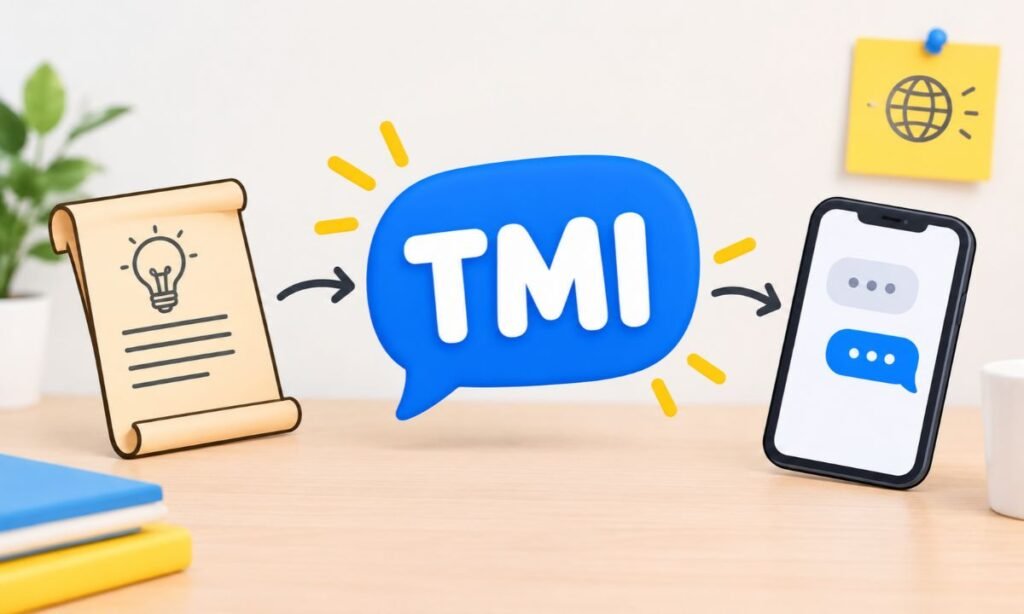
The phrase “too much information” is older than texting. It was used in spoken English as a way to stop someone from oversharing, long before smartphones.
Online chat rooms, forums, and early text messaging then shortened it to TMI. Short messages and fast replies made acronyms a natural fit. Social media pushed it further, since people started sharing personal details with huge audiences, and “oversharing” became a daily topic.
Today it’s one of the best-known internet abbreviations, understood in speech as well as text.
📱 Real-Life Conversations
Seeing TMI in real chats is the easiest way to understand it. Here are three common situations, one per platform.
💚 WhatsApp Chat
Friend 1: I ate three tacos at midnight and now I regret everything.
Friend 2: TMI 😂 but same.
On WhatsApp, TMI usually appears between close friends and family. The tone is relaxed and often joking.
📸 Instagram DMs
Her: Sent you the story. Also, TMI, I haven’t washed my hair in four days.
You: Your honesty is unmatched 😅
In DMs, people often use TMI on themselves, with a self-aware smile. It softens the confession.
🎵 TikTok Comments
Comment: “TMI but this song made me cry in a grocery store.”
Reply: “Same, the cereal aisle saw everything.”
On TikTok, TMI often signals a relatable, slightly embarrassing confession. It tends to attract likes and replies rather than disapproval.
🔍 Other Meanings of TMI
TMI is not only slang. Depending on context, it can mean:
- Three Mile Island, the Pennsylvania nuclear site, often shortened to TMI in news and history.
- Various company, product, or organization abbreviations.
- Technical or industry-specific terms in some fields.
In chats and social media, assume “Too Much Information” unless the topic clearly points elsewhere.
🏥 TMI Meaning in Stroke (Medical Context)
TMI is not a standard abbreviation for stroke. People sometimes mix it up with grading systems that look similar, such as TICI (Thrombolysis in Cerebral Infarction) or TIMI (Thrombolysis in Myocardial Infarction). These describe blood flow after clot treatment.
If you saw “TMI” in a medical document, check the context or ask the clinician who wrote it. Don’t guess, especially about health.
🧠 The Emotional and Psychological Meaning Behind TMI
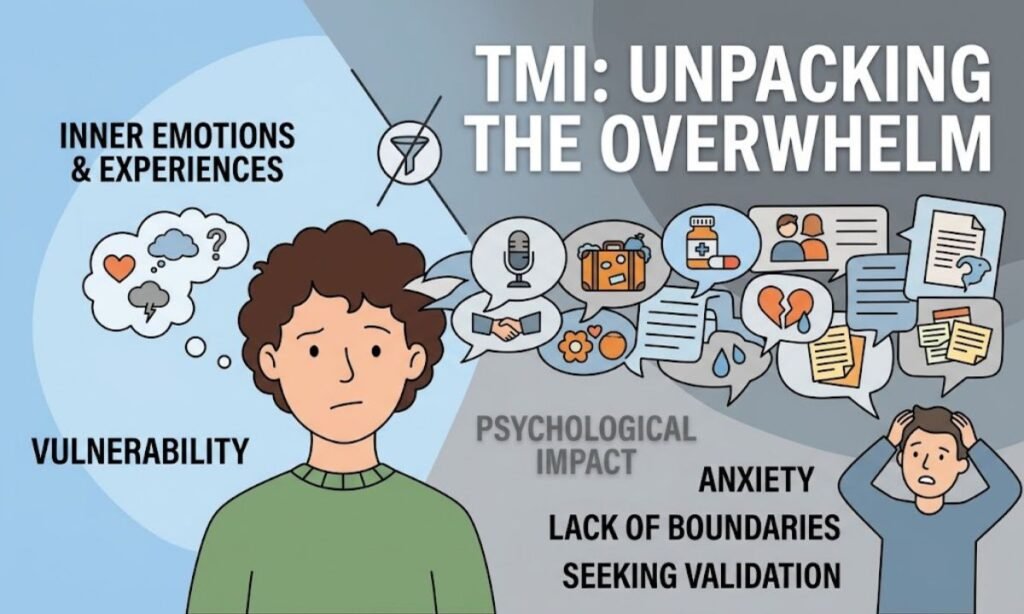
TMI is really about boundaries and comfort levels.
- For the listener: it signals discomfort, embarrassment, or a wish to slow down.
- For the sharer: it can mean nervousness, a need to be heard, or a joke to ease the awkwardness.
Psychologists often link oversharing to wanting connection, reassurance, or relief. That’s why a harsh response can sting. A gentle “TMI” says, “I care, but that’s a lot.”
🌐 Usage in Different Contexts
TMI can sound playful, awkward, or firm depending on who says it and where. Here is how it works in each setting.
📲 Social Media
Used for relatable confessions, humorous captions, and comment replies. Phrases like “TMI warning” prepare viewers for an overshare.
👫 Friends and Relationships
Close friends use TMI playfully. In romantic relationships, it can be affectionate teasing or a real request to hold back certain details. Tone and history matter.
👩 TMI Meaning From a Girl
There’s no special code. When a girl says TMI, it usually means one of two things:
- Playful: teasing, often with emojis (😂, 🙈).
- Boundary: a short, flat “TMI.” with no emoji.
Read the tone, emojis, and your history together. If unsure, ask: “Too much, or just funny?”
💼 Work and Professional Settings
Avoid casual slang in formal emails. Colleagues might say TMI in person or on team chats, but personal health, relationship, or financial details are usually better kept private at work.
🎭 Casual vs. Serious Tone
| Tone | How it sounds | Example |
| Casual | Light, joking | “TMI 😂 but go on” |
| Serious | Short, firm | “TMI. Please stop.” |
❗ Common Misunderstandings About TMI
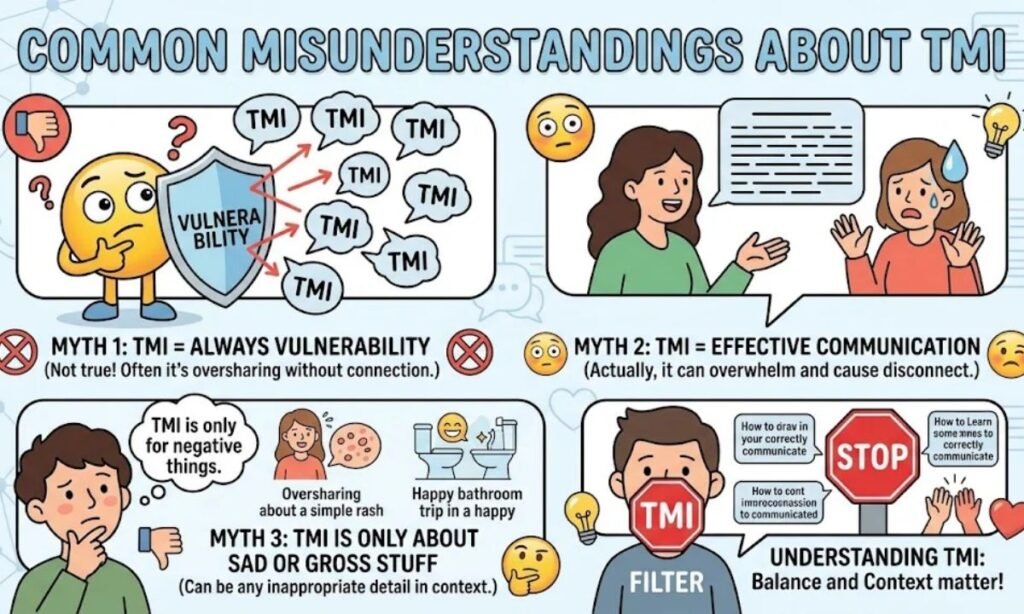
TMI is easy to misread, especially in text where tone is missing. These are the most common mix-ups.
🛑 TMI Does Not Always Mean “Stop Talking”
Often it means “that was a lot, but I’m still here.” Many people say TMI and keep chatting.
🌈 TMI Isn’t Always Negative
It can be affectionate or funny. Sharing something silly and calling it TMI usually builds closeness.
🔐 Personal Topics Aren’t Automatically TMI
Talking about feelings, struggles, or health isn’t oversharing by default. It depends on the listener, the setting, and whether they’re open to it.
⚠️ Avoid Using TMI During Serious Conversations
If someone is opening up about grief, abuse, illness, or mental health, replying “TMI” can feel dismissive. Say instead: “That sounds heavy. Do you want to keep talking about it?”
📊 Comparison Table
| Term | Meaning | Tone | Typical Use |
| TMI | Too much information | Playful or boundary-setting | Chats, social media |
| Oversharing | Revealing too much personal detail | Neutral to critical | Describing behavior |
| TMI alert/warning | Heads-up before an overshare | Humorous | Captions, DMs |
| Ew / Gross | Reaction to unpleasant detail | Reactive | Casual chat |
| Open up | Sharing feelings honestly | Positive | Supportive talks |
🔑 Key Insight
TMI describes how information lands, not whether it’s “bad.” The same sentence can be fine with a best friend and awkward with a coworker.
🎨 Variations and Types of TMI
TMI shows up in many forms, from silly confessions to heavy emotional dumps. Here are the ten most common types.
1. 😂 Funny TMI
Silly confessions shared for laughs: “TMI, but I talk to my plants.”
2. 🩺 Medical TMI
Detailed health or body talk. Often unwelcome at meals.
3. 💕 Relationship TMI
Details about dates, exes, or intimacy that make others uncomfortable.
4. 👨👩👧 Family TMI
A parent or relative sharing something you didn’t need to know.
5. 🏢 Workplace TMI
Personal drama or private details shared with colleagues.
6. 📱 Social Media TMI
Public posts about private matters, often regretted later.
7. 😳 Accidental TMI
A slip of the tongue that reveals more than intended.
8. 😢 Emotional TMI
Heavy feelings dumped without warning or consent.
9. 🤭 Humorous Self-Aware TMI
“I know this is TMI, but…” Speaking the awkwardness first.
10. 📖 Storytelling TMI
Long stories packed with unnecessary details.
💡 How to Respond When Someone Uses TMI
Your reply depends on the tone of the message and your relationship with the person. Here are four ways to answer, from light to serious.
😊 Casual Replies
- “Haha, noted.”
- “Okay, I’ll skip the details.”
🤣 Funny Replies
- “Too late, I’ve already imagined it.”
- “I’ll pretend I didn’t read that.”
😎 Mature and Confident Replies
- “Fair enough, I’ll keep it shorter.”
- “Thanks for telling me. I’ll be mindful.”
🤝 Private and Respectful Replies
- “Let’s talk about this one-on-one.”
- “Understood. I’ll keep that to myself.”
🌍 Regional and Cultural Usage
TMI is understood worldwide, but what counts as “too much” changes from culture to culture. Here is how it plays out in different regions.
🗽 Western Culture
Common and casual, especially among younger people. Directness is generally accepted.
🎤 TMI Meaning in K-pop
Here, TMI has a positive twist. Fans and idols use it for fun trivia: favorite snack, odd habit, or secret talent. A “TMI about me” list is a way to share personality, not to overshare.
🌏 Asian Culture
In many Asian cultures, privacy and modesty are valued. TMI is understood online but may be used more cautiously in formal or family settings.
🕌 Middle Eastern Culture
Family and personal matters are often handled discreetly. English TMI appears in youth chats and social media, but topics like relationships and health may be considered private by default.
🌐 Global Internet Usage
TMI is widely recognized across English-speaking and international online spaces. Its meaning stays consistent, though comfort levels differ by culture.
📈 Is TMI Still Popular? Trends & Online Usage
Yes. TMI remains common because oversharing is everywhere: stories, threads, vlogs, and group chats. It now often shows up as a caption, hashtag, or “TMI thread” where people share quirky confessions on purpose.
It has shifted from criticism to a playful label for honesty.
❓ Frequently Asked Questions
What does TMI mean in text?
It means “Too Much Information,” used when someone shares more than you wanted to know.
Is saying TMI rude?
Not usually, especially when joking. A flat “TMI.” with no emoji can feel firmer, so match your tone to the person.
Can I use TMI at work?
Better avoided in formal emails. In casual team chats it’s okay if your workplace is relaxed.
What does TMI mean from a girl?
It’s usually either playful teasing or a gentle boundary. Check her tone and emojis.
What does TMI mean in K-pop?
It refers to fun, little-known facts about idols or fans, shared as a positive, friendly trivia.
Does TMI mean something in a stroke context?
No, TMI isn’t a standard stroke abbreviation. It’s sometimes confused with TICI or TIMI grading.
What’s a polite way to say TMI?
Try “That’s a bit much for me, but thanks for trusting me.”
✅ Conclusion
TMI is a small acronym with a big job: it helps people manage closeness. Depending on tone, it can be a joke, a boundary, or a way to bond.
When you use it, keep context in mind. With friends, play. With serious topics, be kind. If someone says TMI to you, take it as feedback, not rejection.
And if you ever need to share something heavy, check first: “Is this a good time to talk?”
