

You’ve probably seen “PPM” in a chat, a water report, or a work message and wondered what it means. The PPM meaning is simple: PPM stands for “parts per million.” It’s a way to show how tiny an amount of something is compared with a much larger whole.
This guide covers the meaning, origin, real conversations, other meanings, and tips for using PPM correctly.
💬 What Does PPM Mean in Text? – Quick Explanation
PPM means “parts per million.” It’s a unit that shows how much of a substance is in a larger mixture, such as water, air, or soil. It isn’t texting slang. People use it when they share measurements or reports.
📌 Simple definition
PPM = Parts Per Million. It means one part of something for every one million parts of the whole.
🗣️ In plain words
Picture one drop of ink in a large tank of water. That drop is a tiny share of the total, and PPM puts a number on it.
✨ Quick examples
- “Our tap water reads 300 ppm.”
- “Keep the pool chlorine at 1-3 ppm.”
- “CO₂ in the air is above 420 ppm.”
⚡ Quick Facts
| Feature | Detail |
| Full form | Parts per million |
| Type | Unit of concentration |
| Equals | 0.0001% |
| 1% equals | 10,000 ppm |
| Water shortcut | 1 ppm ≈ 1 mg per liter |
| Mostly used in | Science, water care, air quality, industry |
| Slang? | No, it’s a technical term |
📜 Origin & Background of PPM
🌱 Where it started
The term comes from the French partie par million. Dictionaries record “ppm” in English by the early 1900s, around 1913. Chemists needed a simple way to describe very small concentrations.
🔄 How it evolved
PPM spread from laboratories into many other fields:
- Water testing and treatment
- Air pollution and climate science
- Food safety and farming
- Manufacturing quality control
🌍 Modern influence
Today PPM appears on everyday products and reports. Water quality meters, pool test kits, and air monitors all display it. People who never studied chemistry now read PPM numbers regularly.
📈 Is PPM Still Popular? Trends & Online Usage
Yes, and it’s steady rather than trendy. PPM isn’t slang that rises and falls. It’s a standard unit, so it stays useful as long as people measure things.
Interest tends to grow around:
- Home water filters and TDS meters
- Swimming pool care in warm months
- Climate news, where CO₂ in ppm is often quoted
- Workplace talk, such as quality metrics and project management
In casual chat, people use it mainly when they discuss water, air, or health reports.
💬 Real-Life Conversations Using PPM
Here are three everyday chats where PPM comes up naturally.
📱 WhatsApp Chat – Home Water Filter
Emily: Bought a TDS meter today. Our tap water shows 480 ppm 😮
David: That’s high. What does the filter water show?
Emily: Only 45 ppm after the RO filter.
David: Nice. Under 50 ppm is very clean.
💼 Workplace Slack Conversation
Manager: Quick update on the batch. What’s the defect rate?
Chris: Down to 120 PPM this week, from 300 last month.
Manager: Great. That’s defective parts per million. Keep going.
Chris: Will do. Sending the full report by 5 pm.
📸 Instagram Comment on a Pool Cleaning Reel
User1: What chlorine level should I keep? 🏊
PoolPro: Aim for 1–3 ppm of free chlorine.
User2: I kept it at 6 ppm once and my eyes burned 😅
PoolPro: Yep, too much. Test often and adjust.
🧠 Emotional & Psychological Meaning of PPM
PPM isn’t an emotional word. It’s a unit of measurement, so it carries no hidden feelings or secret message. Still, the way people use it says something about their mindset.
❤️ Why people care about it
PPM is tied to health and safety. A number on a water report or air monitor feels personal. People want to know whether what they drink or breathe is safe.
🎯 What mindset it reflects
Using PPM usually shows a careful, detail-minded attitude. The person wants precision, not guesses. It also reflects the idea that tiny amounts can matter.
🧭 Usage of PPM in Different Contexts

PPM keeps the same core meaning everywhere, but how people use it changes with the setting. Each context below has a real-style example.
1️⃣ Social Media
On social platforms, PPM mostly appears in practical, how-to content.
- Pool care reels: Creators share ideal chemical levels.
- Aquarium and gardening posts: Water and nutrient levels are given in ppm.
- Comment sections: Viewers ask for the “right” number.
📸 Example (Instagram comment):
User: What’s the ideal chlorine level? 🏊
Creator: Keep it between 1-3 ppm and test twice a week.
User: Thanks! Buying a test kit today.
Tip: Verify numbers from social media with a trusted source.
2️⃣ Friends & Daily Life
In everyday talk, PPM comes up when people compare products or check their surroundings.
📱 Example (WhatsApp):
Teena: Got a TDS meter. Our tap water shows 350 ppm.
Robert: Wow, that’s high. Try an RO filter.
Teena: Did it. Now it shows 40 ppm 🎉
It’s casual, informative, and usually tied to a home gadget.
3️⃣ Relationship
PPM has no romantic or emotional meaning. It’s not a code word between partners.
- It may appear as a joke.
- It may come up when a couple shops for a water filter or air purifier.
💬 Example (playful text):
Him: How’s your day going?
Her: My patience is at 2 ppm today 😄
Him: Say no more. Coffee on me ☕
Treat any romantic use as humor only. If someone sends “PPM” with no context, ask what they mean.
4️⃣ Work & Professional Settings
This is where PPM has the most meanings. Always confirm which one is in play.
| Field | PPM Meaning | Example |
| Manufacturing | Defective parts per million | “Our PPM dropped to 120 this month.” |
| Environmental | Parts per million | “Emissions stayed under 50 ppm.” |
| Business | Project portfolio management | “We’re adopting a PPM tool for planning.” |
| Finance | Private placement memorandum | “Please review the PPM before investing.” |
| Office/IT | Pages per minute | “This printer runs at 40 PPM.” |
💼 Example (Slack):
Manager: What’s the defect rate this week?
Alex: 120 PPM, down from 300 last month.
Manager: Excellent. Keep tracking it daily.
5️⃣ Casual vs Serious Usage
| Setting | Tone | Example |
| Casual | Light, conversational | “Pool’s at 2 ppm, all good!” |
| Serious | Formal, precise | “Free chlorine measured 2.0 ppm at 10:30 am on the third test.” |
⚠️ Common Misunderstandings About PPM
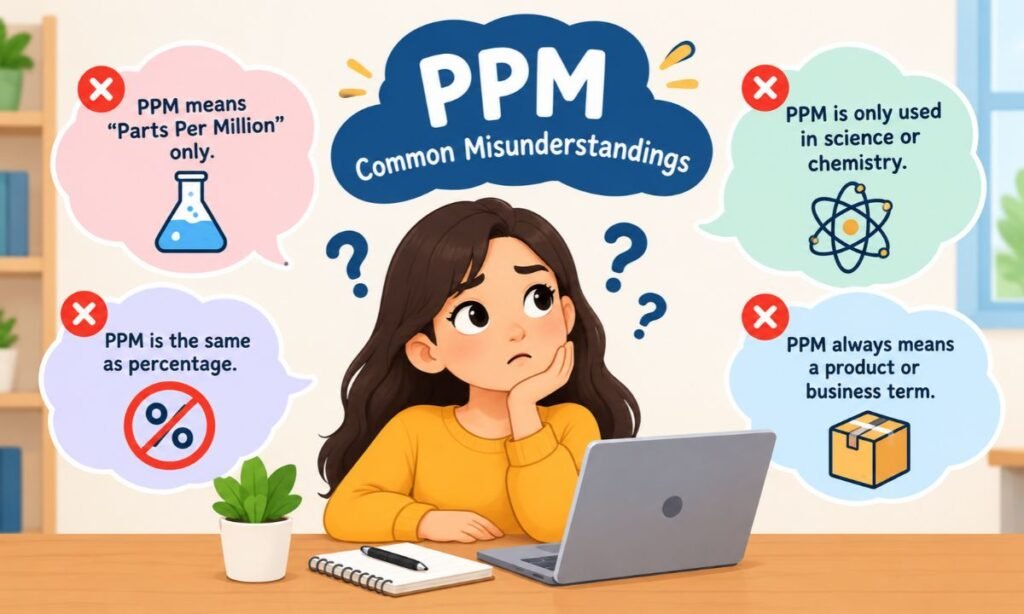
PPM looks simple, but people mix it up often. Here are the three biggest mistakes and how to avoid them.
1. Thinking PPM means percentage
PPM is not percent. A percent is parts per hundred. PPM is parts per million. So 1% = 10,000 ppm.
2. Assuming small means harmless
A small ppm can still matter. Some contaminants are risky even at very low levels. Always compare the number with the safety limit.
3. Using PPM in the wrong context
PPM means different things in different fields. Saying “PPM” to a software team may mean project management, not concentration. Add context when it isn’t obvious.
📊 PPM Comparison Table
| Unit | Meaning | Equivalent | Example use |
| % | Parts per hundred | 10,000 ppm | Alcohol content |
| ‰ | Parts per thousand | 1,000 ppm | Salinity |
| ppm | Parts per million | 1 mg/L (water) | Pool chlorine |
| ppb | Parts per billion | 0.001 ppm | Trace pollutants |
| ppt | Parts per trillion | 0.000001 ppm | Ultra-trace analysis |
🧩 Variations / Types of PPM (Common Uses)
PPM appears in many fields, and the exact meaning shifts with the setting. Here are ten of the most common uses.
🧪 PPM in Chemistry
In chemistry, PPM means parts per million. It describes very dilute solutions and trace substances. In water, 1 ppm is about 1 mg per liter.
Example: “The lab found 0.5 ppm of copper in the sample.”
🩺 PPM in Medical
Medicine uses ppm for small concentrations in products, breath, and air.
- Toothpaste labels list fluoride in ppm (often around 1,000-1,500 ppm).
- Carbon monoxide exposure is measured in ppm.
- Some therapy gases are dosed in ppm.
Example: “The toothpaste contains 1,450 ppm fluoride.”
⚙️ PPM in Engineering
Engineers use ppm to describe tolerances and error rates. It can mean defective parts per million in quality control. It also expresses accuracy, such as a clock crystal rated at ±20 ppm.
Example: “Our supplier’s defect rate is under 100 PPM.”
🌍 PPM in Environmental Science
Scientists track gases and pollutants in the air using ppm. Climate reports often quote CO₂ above 420 ppm. Indoor CO₂ above about 1,000 ppm usually signals poor ventilation.
Example: “Open a window. The room is at 1,300 ppm CO₂.”
🚰 PPM in Water Treatment
Water quality meters show TDS (total dissolved solids) in ppm. Lower numbers usually mean cleaner-tasting water. Many guidelines suggest keeping TDS under about 500 ppm.
Example: “Tap water was 420 ppm. The RO filter brought it to 30.”
🌱 PPM in Agriculture & Gardening
Growers measure nutrients and salts in irrigation water or hydroponic solutions in ppm. Too little starves plants, and too much can burn roots.
Example: “Keep the nutrient solution near 800 ppm for leafy greens.”
🍽️ PPM in Food & Beverage
Food safety rules often set limits in ppm for additives and contaminants. In the US, sulfites must be declared on labels at 10 ppm or more.
Example: “The wine label warns about sulfites since it exceeds 10 ppm.”
🏊 PPM in Pool & Aquarium Care
Pool owners test chlorine, and aquarium keepers test nitrate and other compounds, all in ppm. Pool free chlorine is commonly kept at 1-3 ppm.
Example: “Nitrate hit 60 ppm, so I did a water change.”
💼 PPM in Finance & Business
Here PPM usually means Private Placement Memorandum, a legal document for private investments. In project management, it means Project Portfolio Management.
Example: “Read the PPM carefully before signing.”
🖨️ PPM in IT & Office Tech
In offices, PPM means pages per minute, a printer speed rating. In computing, .ppm is a simple image file format.
Example: “This laser printer runs at 40 PPM.”
💡 How to Respond When Someone Uses “PPM”
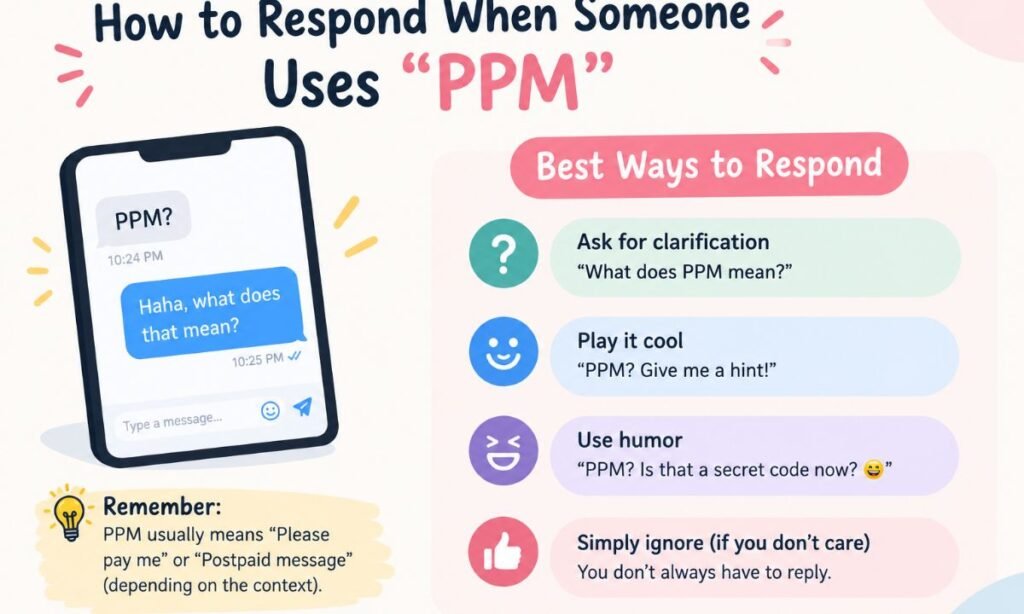
The best reply depends on who is talking and where. First figure out which PPM they mean. Then pick a tone that fits.
😊 Casual Replies
Use these with friends, family, or in group chats.
- “Oh nice, what’s the reading?”
- “Is that good or bad?”
- “Got it, thanks for sharing.”
- “Wait, ppm of what?”
- “Sounds like the filter is working!”
💬 Example:
Sara: Our tap water is 480 ppm 😮
You: Whoa, that’s high. What does the filtered water show?
😄 Funny Replies
Keep these light and only use them when the topic isn’t serious.
- “I only understand parts per pizza 🍕”
- “Parts per million? My bank account is at 2 ppm 😂”
- “Is that the chemistry kind or the printer kind?”
- “My patience is at 5 ppm today.”
💬 Example:
Friend: Pool chlorine is at 2 ppm.
You: Perfect. Now I just need my motivation at 2 ppm 😄
Note: Skip jokes if the reading is a health or safety concern.
😎 Mature & Confident Replies
Use these at work or in professional settings. They show you understand the topic.
- “Could you share the safe limit so we can compare?”
- “That’s within the recommended range, so we’re fine.”
- “Which PPM do you mean, defects or concentration?”
- “Let’s retest to confirm the result.”
- “Please send the full report when you can.”
💬 Example:
Omar: We’re at 120 PPM this week.
You: Good improvement from last month. What’s our target?
🤝 Private or Respectful Replies
Use these when the topic is sensitive, such as a health report or a safety issue.
- “Thanks for letting me know. Want to go over the report together?”
- “I appreciate you sharing that. How can I help?”
- “That sounds worrying. Have you asked a professional?”
- “Let me know if you’d like me to look into it with you.”
💬 Example:
Colleague: My home air test showed high CO ppm.
You: Thanks for telling me. Please get it checked right away. I’m happy to help.
🏆 Expert Tips for Using “PPM Meaning” Correctly
- Check the context first. Science, work, and tech each use it differently.
- Write the full form once. Say “parts per million (ppm)” the first time.
- Include the substance. “2 ppm chlorine” is clearer than “2 ppm.”
- Don’t confuse it with %. Convert when needed: divide ppm by 10,000 for percent.
- Compared with a standard. A number means little without a safe or ideal range.
- Mind the case. “ppm” is standard for the unit. “PPM” is common in business and informal use.
- Use a reliable tester. Cheap meters can be inaccurate, so calibrate them.
- Ask when unsure. A quick question avoids costly mix-ups.
🌏 Regional & Cultural Usage of PPM
🌎 Western Culture
PPM is common in environmental news, pool and aquarium care, and quality control. Climate reports often cite CO₂ in ppm.
🌏 Asian Culture
PPM is widely used in water treatment, manufacturing, and agriculture. In Japan it’s also written as 百万分率 (hyakumanbunritsu). Home TDS meters are popular in many Asian households.
🕌 Middle Eastern Culture
Water quality and desalination make PPM important here. Salinity and drinking water readings are often discussed in ppm.
🌐 Global Internet Usage
Online, PPM looks the same everywhere because it’s an international unit. Only the context changes.
❓ Frequently Asked Questions
What does PPM stand for?
PPM stands for parts per million, a unit that shows tiny concentrations.
Is PPM a slang term?
No. It’s a technical term, not texting slang.
How is PPM different from percentage?
A percent is parts per hundred, while PPM is parts per million. 1% equals 10,000 ppm.
How many mg/L is 1 ppm?
In water, 1 ppm is about 1 mg/L.
What is a safe PPM for drinking water?
Many guidelines suggest total dissolved solids under 500 ppm. Always check local standards.
What is a good chlorine ppm for a pool?
Free chlorine of 1–3 ppm is commonly recommended.
What else can PPM mean?
It can mean pages per minute, project portfolio management, private placement memorandum, or defective parts per million.
Is PPM the same as ppb?
No. A ppb (parts per billion) is 1,000 times smaller than a ppm.
✅ Conclusion
PPM means parts per million. It’s a simple, precise way to describe very small amounts. You’ll find it in water care, air quality, factories, and offices.
Remember three things: it isn’t a percentage, small numbers can still matter, and context decides the meaning. Use these tips and you’ll read, write, and reply to “PPM” with confidence. 🚀
