

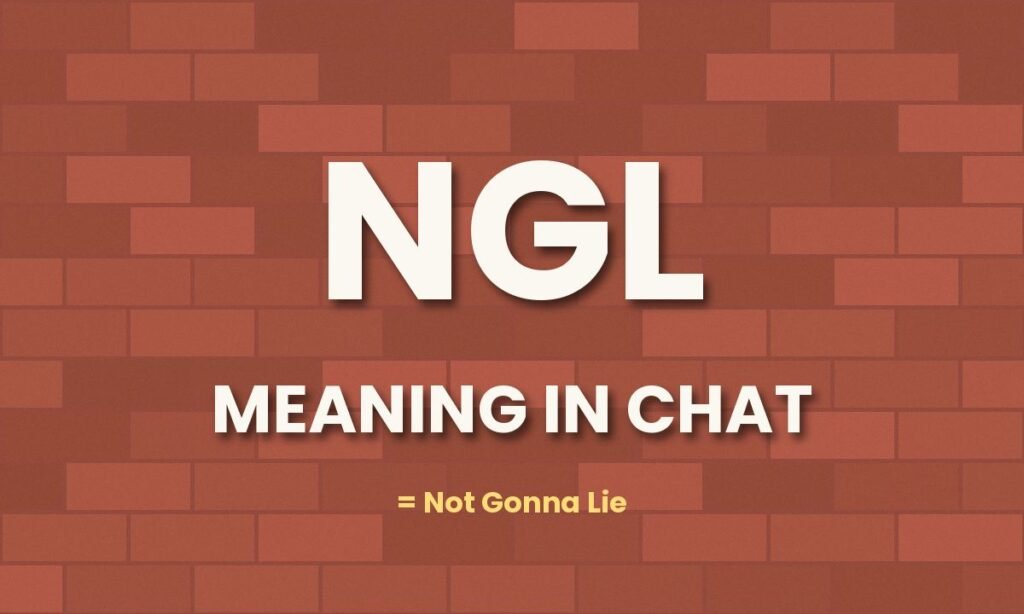
Ever seen “ngl” in a message and wondered what it means? The NGL meaning is simple: it stands for “not gonna lie.” People use it to signal that they’re about to say something honest, whether it’s good, bad, or a little embarrassing.
This guide covers the NGL meaning, origin, platform-by-platform usage, replies, and common mistakes. It also shows how NGL compares with similar slang like TBH and FR.
✅ Meaning of NGL in Chat – Quick Meaning
📖 Simple Definition
NGL is internet slang that introduces or backs up an honest statement. It tells the reader, “I’m being straight with you.”
🔤 Full Form
NGL = Not Gonna Lie
💡 Examples
- “Ngl, that outfit looks amazing.”
- “I’m tired already ngl.”
- “Ngl, I didn’t expect the ending.”
- “That exam was harder than I thought, ngl.”
You can put it at the start or the end of a sentence. The meaning stays the same.
🕰️ Origin and Background of NGL
The phrase “not gonna lie” was common in spoken English long before social media. Texting and chat rooms turned it into a three-letter shortcut.
Early forums, instant messengers, and SMS limits pushed people to type less. As Twitter, Instagram, and Snapchat grew in the 2010s, NGL spread quickly and became part of everyday online talk.
Quick note: “NGL” is also the name of an anonymous Q&A app that went viral in 2021. The app is a different thing. The slang is much older and has nothing to do with it.
📱 Real-Life Conversations Using NGL
These real-life examples show how people use NGL in everyday chats.
🟢 WhatsApp Conversation
Olivia : How was the movie?
David: Ngl, I almost fell asleep 😂
Olivia : Same! The first half was so slow.
📸 Instagram DM
Maya: Did you like my new profile pic?
Zoe: Ngl, it’s your best one yet 🔥
🎵 TikTok Comments
- “Ngl this recipe saved my dinner.”
- “Ngl I watched this five times.”
✉️ Text Messages
Dan: Want to grab pizza tonight?
Leo: Ngl, I’m broke till Friday 😅
🌐 NGL Meaning on Each Platform
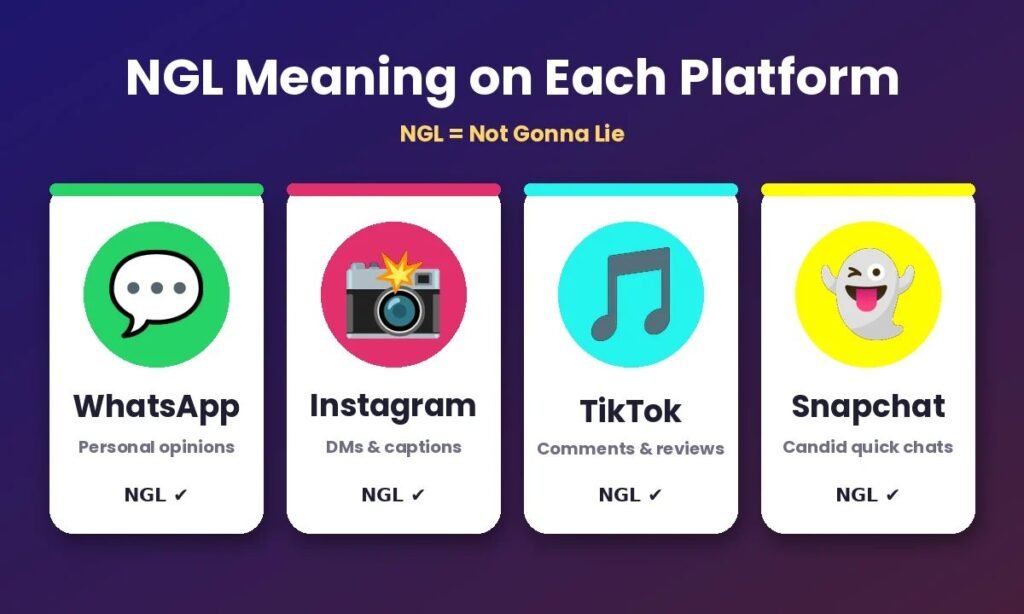
The meaning is the same everywhere. The tone changes with the platform.
🟢 NGL on WhatsApp
WhatsApp chats are personal, so NGL is usually used for honest opinions or small confessions.
Example: “Ngl, I forgot about the meeting completely.”
📸 NGL on Instagram
On Instagram, NGL often shows up in DMs, captions, and replies to Stories. It tends to sound friendly and expressive.
Example: “Ngl, this sunset beats every filter.”
🎵 NGL on TikTok
In TikTok comments, NGL adds personality to a quick reaction or review.
Example: “Ngl, I only came for the comments.”
👻 NGL on Snapchat
Snapchat is fast and casual, so NGL fits well in captions and quick chats. It often marks a vulnerable or candid moment.
Example: “Ngl, I miss school lunches 😭”
| Platform | Typical Tone | Common Use |
| Personal, relaxed | Opinions, confessions | |
| Friendly, expressive | DMs, captions, Story replies | |
| TikTok | Playful, reactive | Comments, reviews |
| Snapchat | Candid, quick | Captions, casual chats |
🧠 The Emotional and Psychological Meaning Behind NGL
Behind the NGL meaning is a simple human need: people use it to be honest, ease social pressure, and feel closer to others.
❤️ Why People Connect With It
People connect with NGL because it makes honest talk feel easy, relatable, and natural in fast-moving online chats.
🤝 It creates honesty.
Saying “ngl” signals that you’re dropping the filter. That makes the message feel more genuine.
😌 It lowers social pressure.
It softens a blunt or awkward statement. “Ngl, I’m not a fan” feels gentler than “I don’t like it.”
🫶 It builds relatability.
Admitting small flaws, like procrastinating or overeating, makes people feel closer to each other.
⚡ It reflects modern communication styles.
Today’s chats are quick, casual, and emotional. NGL packs honesty into three letters.
🧩 Usage of NGL in Different Contexts
NGL works best in casual settings like social media and chats with friends, but it should be swapped for words like “honestly” in formal or professional situations.
📲 Social Media
Use it in captions, comments, and replies to add a candid, human touch.
👫 Friends and Relationships
With friends and partners, NGL works well for light honesty. It can also open a more serious talk, such as “Ngl, I’ve been feeling distant lately.”
💼 Work or Professional Settings
Avoid it in emails, reports, and formal messages. In a relaxed team chat it can be fine, but “honestly” or “to be candid” is safer.
🎭 Casual vs Serious Tone
| Tone | Example | Effect |
| Casual | “Ngl, that meme killed me 😂” | Funny, light |
| Serious | “Ngl, that really hurt my feelings.” | Vulnerable, direct |
Context, emojis, and punctuation decide how it lands.
⚠️ Common Misunderstandings About NGL
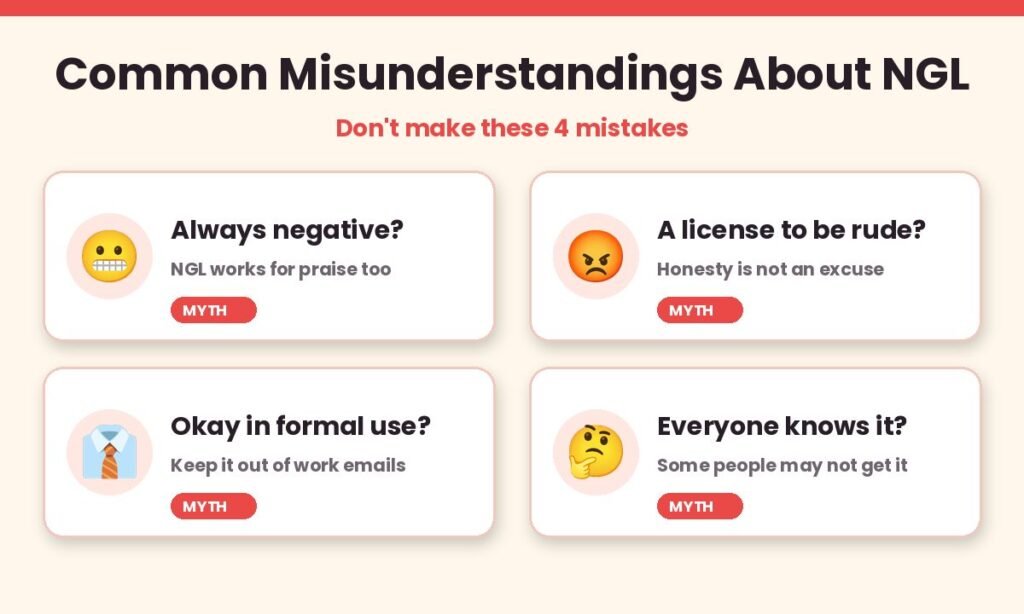
Many people misread NGL as rude, negative, or suitable for any situation, but it’s casual slang that depends on tone and context.
❌ Mistake 1: Assuming It’s Always Negative
NGL works for praise too. “Ngl, you did great” is a compliment.
🚫 Mistake 2: Thinking It Gives Permission to Be Rude
“Ngl, you look bad today” is still rude. The phrase doesn’t cancel the harm.
🏢 Mistake 3: Using It in Formal Situations
It’s slang. Keep it out of job applications, official emails, and academic writing.
🤷 Mistake 4: Assuming Everyone Understands It
Older relatives and non-native English speakers may not know it. If you’re unsure, write “not gonna lie” in full.
📊 Comparison Table: NGL vs Similar Terms
| Term | Meaning | Tone | Best For |
| NGL | Not gonna lie | Honest, casual | Opinions, confessions |
| TBH | To be honest | Honest, casual | Everyday chat |
| FR | For real | Agreeing, emphasizing | Backing someone up |
| No Cap | No lie | Strong emphasis | Proving a point |
| Honestly | Truthfully | Neutral, flexible | Semi-formal use |
| Frankly | Plainly | Formal, direct | Professional use |
🔑 Key Insight
NGL and TBH are nearly interchangeable. NGL leans a bit more toward confessing or admitting something, while TBH feels more neutral.
⚖️ Pros and Cons of Using NGL
Using NGL makes chats quick, honest, and relatable, but it can sound unprofessional or confusing in the wrong setting.
👍 Benefits
- Quick to type
- Signals honesty
- Softens blunt opinions
- Makes you sound natural and relatable
- Works across most platforms
👎 Drawbacks
- Sounds unprofessional in formal settings
- Can be overused
- May confuse people who don’t know slang
- Can be misused to excuse harsh comments
🔁 Variations and Related Expressions
Besides NGL, people use similar expressions like TBH, FR, low-key, and no cap to sound honest, emphasize a point, or keep the tone casual.
1. 💭 TBH
“To be honest.” Almost identical in use: “Tbh, I loved it.”
2. 🔥 FR
“For real.” Shows agreement or emphasis: “That song is great, fr.”
3. 😏 Low-Key
Means “quietly” or “a little.” Example: “I’m low-key excited.”
4. 📢 High-Key
The opposite of low-key, meaning openly or strongly. Example: “I high-key love this show.”
5. 🗣️ Honestly
A flexible, neutral option that works almost anywhere.
6. 💯 Real Talk
Signals a serious, sincere statement: “Real talk, you should rest.”
7. 🧢 No Cap
“No lie.” Adds strong emphasis: “Best burger ever, no cap.”
8. 🙈 I Can’t Even Lie
A more dramatic cousin of NGL: “I can’t even lie, I cried.”
9. 📝 Truthfully
Slightly more polished, suitable for semi-formal chats.
10. 🎯 Frankly
A direct, formal choice for work or serious discussions.
💬 How to Respond When Someone Uses NGL
When someone uses NGL, you can reply casually, with humor, or with a thoughtful answer, depending on the tone and how personal the message is.
😊 Casual Replies
- “Haha, fair enough.”
- “Appreciate the honesty!”
- “Same, ngl.”
😂 Funny Replies
- “Wow, ngl hit me right in the feelings 😭”
- “Thanks for the honesty, I’ll go cry now 😂”
😎 Mature and Confident Replies
- “I value your honesty. Tell me more.”
- “Good to know. Thanks for being upfront.”
🔒 Private and Respectful Replies
If the message was personal or emotional, reply gently or move to a private chat:
- “Thanks for telling me. Want to talk about it?”
🌍 Regional and Cultural Usage
Western Culture
NGL is most common in the US, UK, Canada, and Australia, especially among teens and young adults.
Asian Culture
Younger, English-speaking users in India, Pakistan, the Philippines, and Singapore use it widely in chats and on social media.
Middle Eastern Culture
Bilingual young people often mix NGL into Arabic or English chats, mostly on Instagram and Snapchat.
Global Internet Usage
Global platforms have turned NGL into an international slang term, understood well beyond English-speaking countries.
📈 Is NGL Still Popular? Trends & Online Usage
📊 Is Usage Growing or Declining?
It’s stable and still widely used. Newer slang comes and goes, but NGL has stayed a standard part of casual online English.
👥 Who Uses It Most?
Gen Z and younger millennials, though many older users have picked it up too.
📍 Where Is It Commonly Seen?
Text messages, WhatsApp, Instagram, TikTok, Snapchat, X (Twitter), and gaming chats.
⚡ Quick Facts About NGL
- Full form: Not Gonna Lie
- Type: Internet slang / acronym
- Tone: Casual and honest
- Used for: Opinions, confessions, emphasis
- Best avoided in: Formal writing
- Close synonyms: TBH, honestly, real talk
❓ Frequently Asked Questions
What does NGL mean in text?
It means “not gonna lie,” used to introduce an honest opinion or admission.
Is NGL rude?
No, but it can sound harsh if the statement that follows is unkind.
What is the difference between NGL and TBH?
They’re nearly the same. NGL leans toward confessions, while TBH is a bit more neutral.
Can I use NGL at work?
Only in relaxed team chats. In emails or formal messages, use “honestly” or “frankly.”
Is NGL the same as the NGL app?
No. The slang is an old acronym, while the NGL app is an anonymous Q&A platform that went viral in 2021.
Is NGL capitalized?
Either works. Lowercase “ngl” is the most common in casual chats.
Is NGL only for negative statements?
No. It’s used just as often for compliments and positive feelings.
🏁 Conclusion
NGL means “not gonna lie,” and it’s one of the most useful honesty markers in online chat. It’s short and flexible, and it makes conversations feel more genuine.
Use it in casual chats with friends and on social media. In professional settings, switch to “honestly” or “frankly.”
Next time you see “ngl” pop up, you’ll know what it means and how to reply.
