

You get a text that says, “Miss you, BFF!” It’s friendly, but what exactly does it mean? Is it a casual compliment or a real statement about your friendship?
BFF is one of the most recognised abbreviations in texting. It looks simple, but the tone, the sender, and the situation can change how it lands. This guide covers the BFF meaning in text, its origin, examples, replies, and the mistakes to avoid.
📱 What Does BFF Mean in Text? – Quick Definition
BFF stands for “Best Friends Forever.” In texting and on social media, it describes your closest friend or works as an affectionate nickname for them.
✅ Simple Meaning
BFF = Best Friends Forever.
In text, it describes your closest friend, or it’s a warm nickname you use when talking to them. People also write it as “bff” in lowercase, and the plural is “BFFs.”
💌 Example Messages
- “Happy birthday, BFF! 🎂”
- “Can’t wait to see you this weekend, bff.”
- “My BFF just sent me the funniest meme.”
- “Thanks for listening last night. You’re the best, BFF.”
- “Meet my BFF, Sara.”
⚡ Quick Facts
| Feature | Details |
| Full form | Best Friends Forever |
| Type | Initialism (each letter is said aloud: B-F-F) |
| Tone | Warm, casual, affectionate |
| Plural | BFFs |
| Common platforms | WhatsApp, Instagram, Snapchat, iMessage, TikTok |
| Formal use | Not recommended |
| Capitalisation | BFF or bff, both are fine |
🕰️ Origin and Background of BFF
The idea of a “best friend” is very old. The shortened form is much newer. BFF has been in use since at least 1996. It spread quickly through school notebooks, friendship bracelets, and early chat tools. grammarly
Early texting made short forms useful. Typing on a number keypad was slow, and messages had character limits. Short forms like BFF saved time and also felt personal.
📈 Key Moments in Its Popularity
- Late 1990s: Used in school culture and early online chat rooms.
- Early 2000s: Became common on instant messengers and SMS.
- Late 2000s: Moved to social networks like Facebook and MySpace, where people listed their “top friends.”
- 2010s: Instagram captions, Snapchat streaks, and story shoutouts made it a daily phrase.
- Today: Friend-finding apps such as Bumble BFF have turned the term into a product name as well.
📊 Is BFF Still Popular? Trends & Online Usage
Yes, though how people use it has shifted. Younger users sometimes see it as a little old-fashioned. Even so, it hasn’t disappeared.
It has found new life in a few places:
- Captions and tags: “Me and my BFF 💕”
- Memes and reels: Often used playfully or sarcastically.
- Friend apps: Platforms for meeting new people use “BFF” in their branding.
- Gift culture: Mugs, bracelets, and cards still carry the word.
Many people now say “bestie,” “my person,” or “ride or die” for the same idea. BFF remains the version nearly everyone understands, across ages and countries.
🗨️ Real-Life Conversations Using BFF
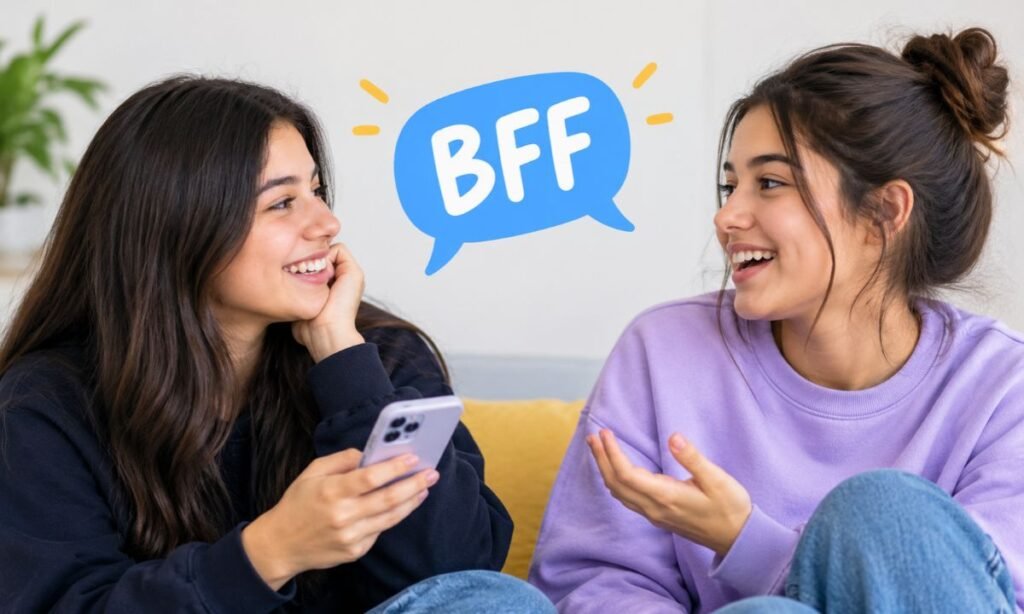
Seeing BFF in real chats makes the tone easier to understand. Here are three everyday examples from different platforms.
🟢 WhatsApp Conversation
Emily: Did you reach home safely?
Teena: Yes, just got in. Thanks for dropping me, BFF 😘
Emily: Anytime! Text me before you sleep.
Teena: Always. Love you!
📸 Instagram DM Conversation
Zoya: Okay, your new profile pic is stunning 😍
Hira: Stop, you’re too kind! My bff always hypes me up
Zoya: That’s literally my job
Hira: Coffee this weekend?
📩 Text Message Conversation
Daniel: Bro, I got the job!
Chris: WHAT?! Congrats, my BFF is going places 🔥
Daniel: Dinner is on me.
Chris: Now you’re talking.
🧠 Emotional and Psychological Meaning
BFF is more than a label. It reflects what people need from close friendships.
🏡 1. Belonging
Calling someone your BFF says, “You’re part of my inner circle.” That feeling of being chosen is a basic human need. It makes people feel safe and understood.
🤝 2. Loyalty
The word carries an unspoken promise: I’ve got your back. Friends who use it usually share secrets, support each other in hard times, and stay in touch even when life gets busy.
🌐 3. Identity and Social Bonding
Friendships shape how we see ourselves. Sharing a BFF label, whether in a caption, a matching bracelet, or an inside joke, gives a friendship a public identity. It says, “This is my person, and I’m proud of it.”
🌍 Usage in Different Contexts
BFF can sound different depending on where you use it and who you say it to. Here is how it works in each setting.
📲 Social Media
On Instagram, TikTok, and Snapchat, BFF appears in captions, comments, and story tags. It works as a quick public thank-you or celebration of a friend.
👭 Friends and Relationships
Between friends, BFF is a warm label. It can sit alongside a romantic relationship, but it generally signals a platonic bond. Some people use it for a partner as a joke (“my husband is my BFF”), which is fine when the tone is clear.
👨 BFF Meaning in Text From a Guy
When a guy texts “BFF,” it usually means he sees you as a very close friend. Guys often use it jokingly with each other (“my BFF is late again 😂”).
If he uses it with a girl he’s close to, read the whole context. In most cases it means genuine friendship, sometimes with a playful or flirty tone, but the word itself doesn’t say romance.
👩 BFF Meaning in Text From a Girl
From a girl, BFF is usually a sincere sign of closeness. It often comes with emojis, hearts, and affectionate nicknames. Girls also use it as a quick compliment, such as “Thanks, BFF, you saved me!”
💼 Work or Professional Settings
BFF doesn’t belong in formal emails or client messages. With close coworkers on a casual chat channel, a light “my work BFF” is fine. If your workplace culture is strict, skip it.
🎭 Casual vs Serious Tone
| Tone | How BFF Sounds | Example |
| Casual | Playful, light | “BFF, pass me the fries 🍟” |
| Emotional | Sincere, warm | “You’re my BFF, and I’m so grateful for you.” |
| Sarcastic | Teasing | “Oh sure, BFF, steal my hoodie again.” |
| Formal | Out of place | Avoid |
⚠️ Common Misunderstandings
Because BFF looks so simple, people often misread it or misuse it. These are the three most common mistakes.
1. Assuming It Always Means “Forever”
The “F” for forever is more of a feeling than a promise. Friendships change, and some drift apart. Someone calling you BFF means they value you now, not that they’ve signed a lifetime contract.
2. Overusing It
If you call everyone BFF, the word loses its weight. Save it for people who really are close, or the label starts to feel generic.
3. Using It in Formal Situations
Writing “Dear BFF” in a business email, or using it in a job application, looks unprofessional. Keep it for personal chats.
🔍 Comparison with Similar Terms
| Term | Meaning | Closeness Level | Tone |
| BFF | Best Friends Forever | Very high | Warm, classic |
| Bestie | Best friend | Very high | Casual, trendy |
| BF | Boyfriend (or best friend, by context) | Depends | Context-based |
| Bae | Romantic partner or loved one | High | Romantic or playful |
| BFFL | Best Friends For Life | Very high | Dramatic, emphatic |
| Bro / Sis | Brother / sister, friendly address | Medium to high | Casual |
| Homie | Close friend | Medium to high | Slangy |
Tip: “BF” can mean boyfriend or best friend, so the surrounding words decide it.
🎀 Variations and Types of BFF (Common Online Forms)
1. BFFL
Short for “Best Friends For Life.” It’s a stronger, more dramatic version.
2. Work BFF
The coworker who shares lunch, gossip, and survival tips for Monday meetings.
3. School BFF
The friend who shared your class notes, your lunch table, and your embarrassing school stories.
4. Childhood BFF
Someone who has known you since you were small. This bond often has the deepest history.
5. Internet BFF
A friend you met through games, forums, or social apps. You may never have met in person, but the bond is real.
6. Long-Distance BFF
A best friend who lives in another city or country. Video calls, voice notes, and late-night chats keep the friendship alive.
7. BFF Goals
A phrase for friendships people admire online. It often appears under photos of friends supporting each other.
8. Temporary BFF
A friend made for a trip, a course, or an event. The closeness is real, but may last only for a season.
9. Gym BFF
Your workout partner who keeps you accountable and celebrates your personal bests.
10. Travel BFF
The person you can trust with the map, the luggage, and your sleep schedule on a long journey.
💬 How to Respond When Someone Calls You BFF
When someone calls you BFF, a quick and warm reply works best. Pick the style that fits your friendship and your comfort level.
😊 Casual Replies
- “Aww, you’re my BFF too!”
- “Always here for you!”
- “Love you, bff 💛”
😂 Funny Replies
- “Careful, I might start charging for BFF services.”
- “BFF status confirmed. Snacks are now mandatory.”
- “Only if you keep sharing your fries.”
💪 Mature or Confident Replies
- “That means a lot to me. You’re a great friend.”
- “I’m glad we have each other.”
- “Same here. I really value our friendship.”
🔒 Respectful or Private Replies
If you’re not comfortable with the label, you can still be kind:
- “Thank you, I really appreciate our friendship.”
- “You’re a wonderful friend, and I’m happy we’re close.”
You don’t have to match the label to be honest and polite.
🌏 Regional and Cultural Usage
BFF is understood almost everywhere, but how people use it changes from place to place. Here is how it looks across different cultures.
🗽 Western Culture
BFF is very common in the US, UK, Canada, and Australia. It shows up in school life, pop culture, and social media, and it’s often used openly in public posts.
🏯 Asian Culture
In countries such as India, Pakistan, the Philippines, and Japan, BFF is widely understood through English-language media and social platforms. Many people mix it with local words for friend, such as “yaar” or “dost,” in the same message.
🕌 Middle Eastern Culture
Younger, English-speaking users in the region use BFF freely online, often next to Arabic terms like “sadiqi” or “habibi/habibti.” Closeness is typically expressed with a mix of English and local words, and public tone is usually more reserved than in the West.
🌐 Global Internet Usage
Online, BFF has become a shared piece of internet language. Because it’s short, positive, and easy to type, it travels across languages without much explanation.
❓ Frequently Asked Questions
What does BFF mean in text?
BFF means “Best Friends Forever” and is used for a very close friend.
Is BFF the same as bestie?
They mean almost the same thing. “Bestie” sounds more current and casual, while BFF is the classic version.
Can a guy use BFF?
Yes. Guys use it jokingly or sincerely, usually for a close friend.
Can BFF mean something romantic?
Not by itself. It’s a friendship term, so check the tone and context if you’re unsure.
Is BFF formal or informal?
It’s informal. Keep it out of professional emails and official writing.
What is the plural of BFF?
The plural is BFFs.
Is it okay to call a coworker my BFF?
Yes, if the workplace is relaxed and the coworker is truly a close friend. Avoid it in formal communication.
What is the difference between BFF and BFFL?
BFFL means “Best Friends For Life,” which is a stronger, more emphatic version of BFF.
Is BFF still used in 2026?
Yes. It’s less trendy than “bestie,” but people still use it widely in captions, chats, and memes.
How do I reply if someone calls me BFF?
Match their warmth with something simple like “Aww, you’re my BFF too!” If you’re unsure, thank them for the friendship.
🏁 Conclusion
BFF stands for “Best Friends Forever,” but its real meaning sits in the feeling behind it: trust, loyalty, and closeness. It’s easy to use, easy to understand, and warm in nearly any friendly text.
Use it with people who matter, match the tone of the conversation, and skip it in formal settings. Whether you’re replying to a message or sending one, a simple “BFF” can say a lot in three letters. 💕
