

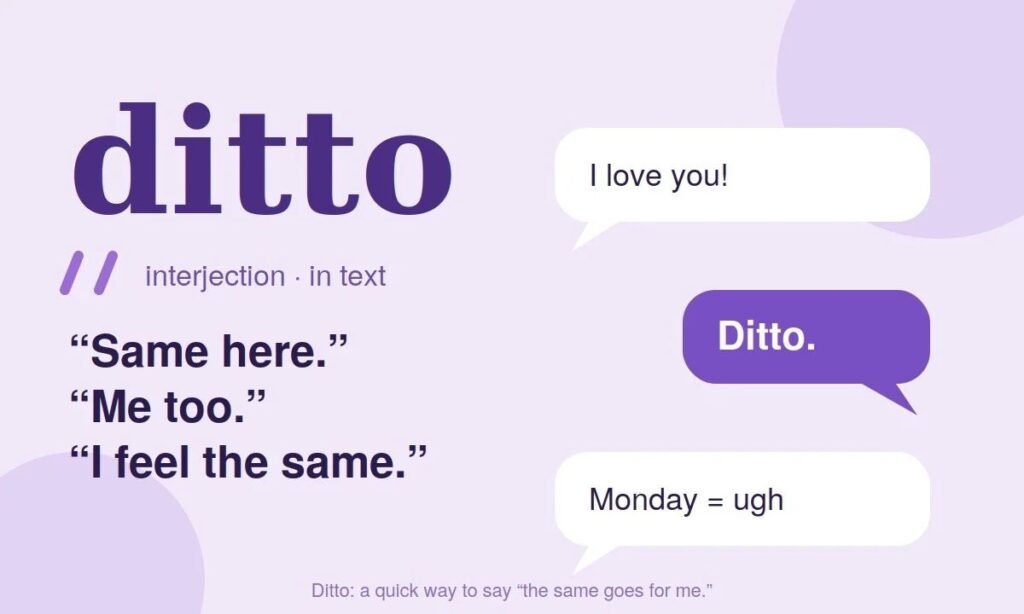
Ditto meaning in text is simple: it’s a quick way to say “me too” or “I feel the same.” But when you receive a one-word “ditto,” it’s easy to wonder what the sender really meant. This short word shows up in WhatsApp chats, Instagram DMs, and TikTok comments every day.
In this guide, you’ll get a clear definition, real chat examples, and tips on when ditto sounds sweet and when it sounds cold. You’ll also find easy replies you can send back right away.
✅ What Does Ditto Mean in Text – Quick Definition
Ditto means “the same,” “me too,” or “I feel the same way.” In a text message, it’s a short reply that agrees with or repeats what the other person just said, without typing it all out again.
Think of it as a verbal copy-and-paste. It’s informal, quick, and usually friendly.
📝 Simple Examples
- Them: “I’m so tired today.” You: “Ditto.”
- Them: “Can’t wait for the weekend!” You: “Ditto!”
- Them: “Love you.” You: “Ditto.”
- Them: “Pizza for dinner?” You: “Ditto, I’m starving.”
In each case, “ditto” replaces a full sentence like “I feel the same.”
📜 Origin & Background
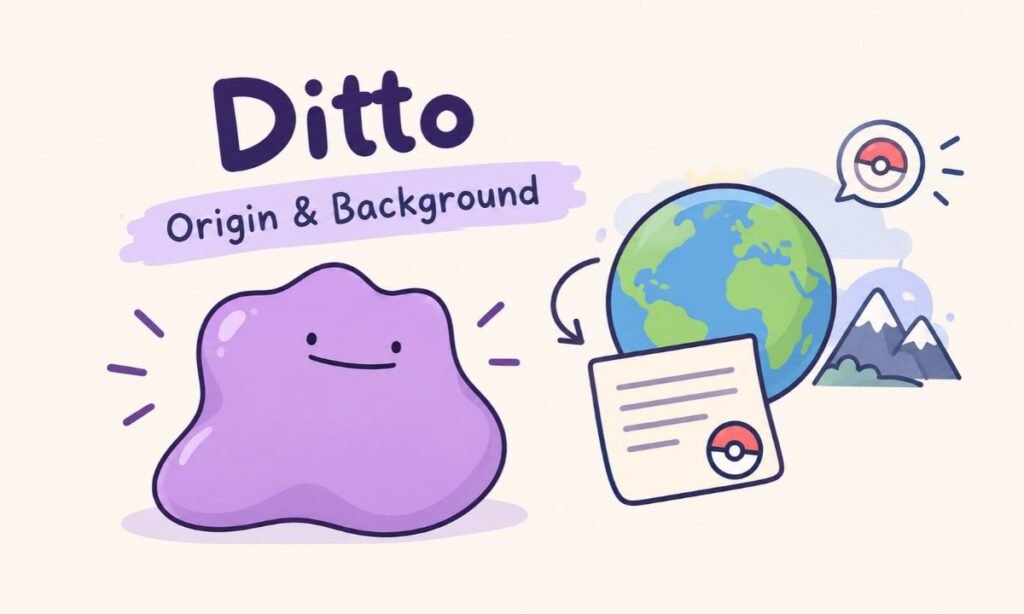
Ditto is much older than texting. It comes from the Italian word detto, meaning “said.” Detto itself traces back to the Latin verb dicere, “to say.”
🔄 How It Evolved
- Early 1600s: Italian merchants used it in ledgers to avoid rewriting the same month or date.
- 1600s–1700s: English writers adopted it to mean “the same as above.”
- Later spoken use: People began saying it aloud to agree with someone.
- 20th century: “Ditto machines” (spirit duplicators) made copies in schools and offices, so “ditto” also meant a copy.
- Digital age: Texting, DMs, and comments turned it into a quick agreement word.
The meaning never really changed. It always meant “same as before.” Only the place we use it moved from paper to phone screens.
📱 Real-Life Conversations (How People Actually Use Ditto)
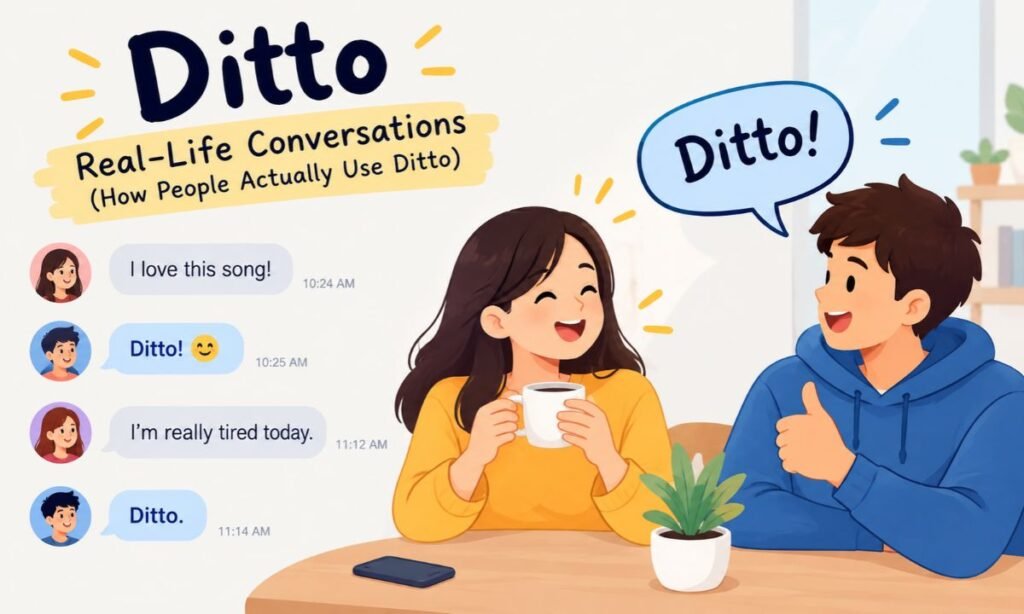
1. WhatsApp Chat
David: Just reached home, so exhausted 😩
Teena: Ditto. Long day.
Here, “ditto” shows shared tiredness. It’s casual and relatable.
2. Instagram DMs
Friend: That reel was hilarious 😂
You: Ditto, I replayed it three times.
On Instagram, ditto often follows a reaction to a post or story.
3. Text Messages
Partner: Good night, love you.
You: Ditto 💛
This is the classic romantic use. It’s short, soft, and a bit playful.
4. TikTok Comments
Comment: “This song is stuck in my head.”
Reply: “Ditto 😭”
On TikTok, “ditto” works like a like button in words. It tells the commenter, “You’re not alone.”
🧠 Emotional & Psychological Meaning
💡 Why People Use It
- Speed: It’s faster than typing a full reply.
- Connection: It signals “I’m on your wavelength.”
- Comfort: It’s easier to say than a heavy phrase like “I love you too.”
- Playfulness: It adds a light, retro tone.
🪞 What It Reflects
Ditto often reflects agreement, closeness, and ease. Between close friends, it feels natural. For some people, it also reflects shyness or emotional caution, because it lets them respond warmly without making a big statement.
🌍 Usage in Different Contexts
1. 📲 Social Media
On Instagram, TikTok, and X, ditto is common in replies and comments. It keeps threads short and shows quick agreement.
2. 👫 Friends & Relationships
Among friends, it’s casual and fun. In relationships, it can be affectionate. Some partners find it sweet, while others want the full words. Tone and habit matter.
3. 💼 Work or Professional Settings
In Slack or team chats, “ditto” is fine for quick agreement with colleagues, as in “Ditto on Sarah’s point.” In emails to clients or managers, choose “I agree” or “Same here.”
4. 🎭 Casual vs Serious Tone
| Situation | Is “Ditto” OK? | Better Option |
| Friend chat | ✅ Yes | Ditto! |
| Flirty message | ✅ Usually | Ditto 😊 |
| Team chat | ⚠️ Sometimes | Agreed. |
| Formal email | ❌ No | I share your view. |
| Serious or emotional talk | ❌ Risky | Say the full sentence |
⚠️ Common Misunderstandings
1. Thinking It’s Always Romantic
Ditto does not always mean “I love you.” It can respond to anything, from hunger to boredom to a movie opinion.
2. Assuming It Means Copying
In texting, ditto means agreeing, not copying. You aren’t duplicating the message, just matching the feeling.
3. Using It in Formal Writing
Ditto is informal. Avoid it in reports, cover letters, and official emails.
4. Overusing It
If every reply is “ditto,” the chat can feel flat. Mix it with real sentences so the other person feels heard.
📊 Comparison Table
| Phrase | Meaning | Tone | Best For |
| Ditto | Same here | Casual, light | Friends, DMs |
| Same | Me too | Very casual | Quick chats |
| Me too | Agreeing | Neutral, warm | Most situations |
| Likewise | Same to you | Polite | Semi-formal |
| Agreed | I agree | Professional | Work |
| Right back at you | Returning a sentiment | Friendly, playful | Compliments, greetings |
🔑 Key Insight
“Ditto” sits between “me too” and “likewise.” It’s warmer than “agreed” and less formal than “likewise.” That small shade of tone is why people choose it.
🎨 Variations / Types of Ditto (Modern Usage)
- Ditto! The standard, cheerful version.
- Ditto 💛 / Ditto ❤️: Affectionate, often romantic.
- Big ditto: Strong agreement.
- Ditto that: Backing up someone else’s comment.
- Same, ditto: Emphasis in casual chats.
- Ditto mark (〃): A symbol used in lists to repeat the item above.
- Ditto (Pokémon): The shape-shifting character, which is a different meaning entirely.
👨👩 What Does Ditto Mean From a Guy or Girl?
The meaning is the same for everyone: “I feel the same.” The difference is in the context.
- From someone you’re dating: Usually affection, sometimes mild shyness.
- From a friend: Plain agreement.
- From a crush: Possibly interest, but read the full conversation, not just one word.
Gender doesn’t change the definition. Tone, emojis, and relationship do.
😊 Is Ditto Positive, Negative, or Neutral?
Ditto is mostly positive or neutral. It carries the mood of whatever it answers. If someone shares good news, “ditto” feels happy. If someone shares frustration, it feels supportive. It only turns negative when used in the wrong moment.
😬 Can Ditto Sound Rude or Dismissive?
Yes, sometimes. A one-word “ditto” can feel cold when:
- Someone shares something emotional.
- You apologize and get “ditto” back.
- Every reply in the chat is “ditto.”
If the moment matters, add a few words: “Ditto, I really mean that.”
🕰️ Where Did the Word Ditto Come From?
It came from Italian detto (“said”), used in business records in the early 1600s. English speakers borrowed it for “the same as above.” Over time it moved into speech as an agreement word, then into copying (ditto machines), and finally into text and chat.
💌 How to Respond When Someone Says Ditto
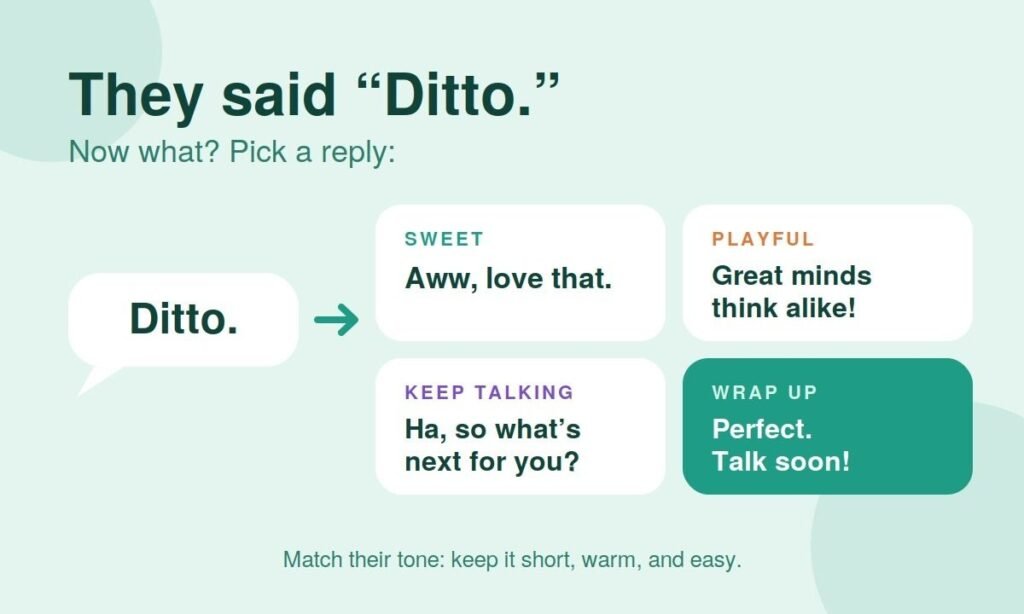
😎 Casual Replies
- “Haha, same!”
- “Glad we’re on the same page.”
- “Good to know 😊”
😂 Funny Replies
- “Great minds think alike.”
- “Are we copying each other now?”
- “Ditto to your ditto.”
🤝 Mature / Confident Replies
- “I appreciate that.”
- “Good, that makes me happy.”
- “Nice, it’s mutual then.”
🔒 Private or Respectful Replies
- “Thank you, that means a lot.”
- “I’m glad you feel that way.”
- “Let’s talk more later.”
🌐 Regional & Cultural Usage
Western Culture
In the US, UK, and Canada, ditto is casual and widely understood. The 1990 film Ghost made “ditto” a famous stand-in for “I love you too,” so it’s often seen as a romantic shorthand.
Asian Culture
Among English speakers in South Asia and East Asia, ditto is understood in chats, especially among younger users. Some people use it for “same here,” while others stick to “me too” or “same.” Translations may lose the nuance.
Middle Eastern Culture
Younger bilingual users are familiar with it online, but many switch to Arabic or Urdu expressions for agreement or affection. Used in English, it’s seen as light and trendy, not deeply emotional.
Global Internet Usage
Online, “ditto” is simply shorthand. Meme culture, gaming chats, and social media comments all use it, usually with an emoji to set the tone.
❓ Frequently Asked Questions
What does ditto mean in a text from a girl?
It means she feels the same way. Check her tone and emojis to judge how warm it is.
What does ditto mean from a guy?
It’s the same: agreement or shared feeling, sometimes affection. Context decides.
Is ditto the same as “I love you too”?
Only when it replies to “I love you.” Otherwise it just means “same here.”
Is ditto formal or informal?
It’s informal. Use “agreed” or “likewise” in professional writing.
Is it rude to reply with just “ditto”?
Not usually, but it can feel cold in emotional moments. Add a few words if it matters.
What is the plural of ditto?
Dittos (some dictionaries also accept dittoes).
What is a ditto mark?
It’s the symbol 〃 used in lists to mean “same as above.”
What’s another word for ditto?
Same, me too, likewise, agreed, or “same here.”
Is ditto still used today?
Yes. It’s common in texts, DMs, and social media comments.
🏁 Conclusion
Ditto is a small word with a long history. It began in Italian ledgers and now lives in WhatsApp chats and TikTok comments. In text, it means “me too” or “same here,” and its warmth depends on tone and timing.
Use it with friends, partners, and in casual chats. Skip it in formal writing, and add real words when the moment is emotional. Used well, one little “ditto” can say a lot.
