

If you’ve been scrolling through Instagram comments, Snapchat streaks, or a group chat and spotted the word “ion” sitting there with no context, you’ve probably paused and thought, “wait, what does that even mean?” 😅
You’re not alone. “ION” is one of those small texting terms that looks confusing at first but is actually super simple once someone breaks it down for you. It’s everywhere :in DMs, comment sections, captions, and casual conversations between friends :and it’s not going away anytime soon.
In this guide, we’ll cover exactly what ION means, where it comes from, how people use it across different platforms, and when you should (or shouldn’t) use it yourself. Let’s get into it. 🚀
What Does ION Meaning in Text? 📝
In everyday texting, ION is a casual, phonetic shorthand for “I don’t.” 💬
It comes from the way “I don’t” naturally sounds when someone says it quickly out loud. Say “I don’t” fast a few times :it starts to blend together and sound a lot like “i-on.” Over time, that pronunciation made its way into typed conversations, and people simply started spelling it the way it sounds.
So instead of typing:
“I don’t know what you mean.”
Someone might type:
“ion know what you mean.”
This usage is rooted in African American Vernacular English (AAVE), and it gained massive popularity through Black Twitter before spreading to TikTok, Instagram, and mainstream texting culture around the mid-to-late 2010s. Today it’s considered standard Gen Z internet slang. 🔥
It’s worth noting there’s a second, less common meaning. Written in all caps (“ION”), some people use it as shorthand for “In Other News,” especially when shifting a conversation to a new topic. However, the lowercase “I don’t” meaning is by far the more common one you’ll encounter in day-to-day texting.
Where Is ION Commonly Used? 🌍
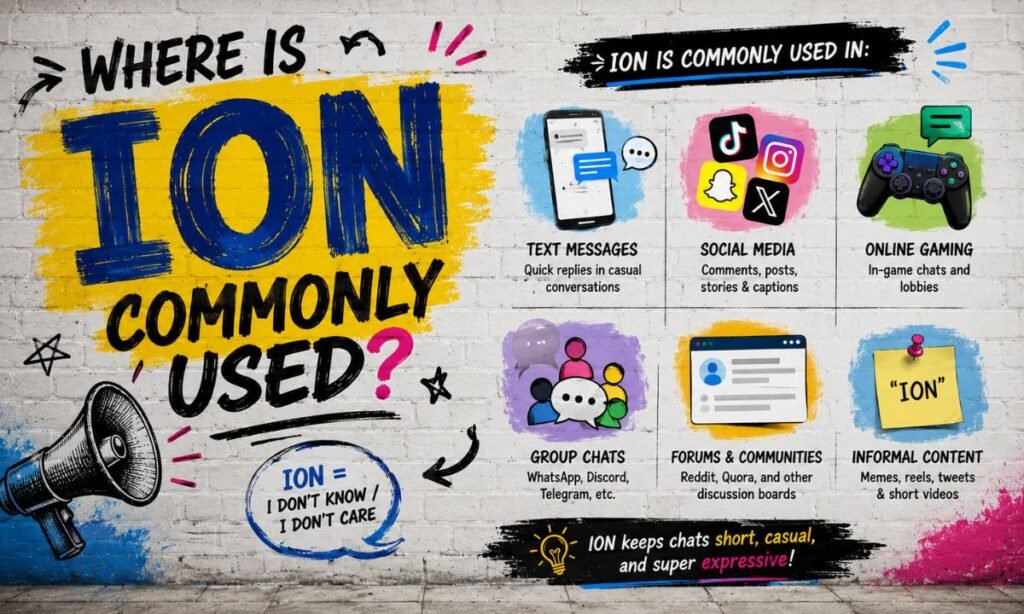
ION shows up most in fast, informal digital spaces where speed and personality matter more than proper grammar. You’ll typically spot it in:
- Text messages between friends or in group chats 📱
- Instagram comments and captions
- Snapchat chats
- TikTok comment sections
- Twitter/X replies
- Dating app conversations
- Gaming chats (Discord, Xbox/PlayStation messages)
It thrives in places where people are typing fast, want to sound relaxed, and aren’t worried about formal grammar rules. You almost never see it in emails, resumes, or professional Slack messages :and for good reason, which we’ll get to shortly.
Examples of ION in Conversation 💬
Seeing ION used in real conversations makes it much easier to understand naturally. Here are some everyday examples:
- A: “Are you coming to the party tonight?”
- B: “ion think so, I’m tired 😴”
- A: “Did you finish the assignment?”
- B: “ion even started it yet lol”
- A: “Why didn’t you text back?”
- B: “ion see your message till now, my bad”
- A: “You like pineapple on pizza?”
- B: “ion mess with that at all 🍕🚫”
In every case, “ion” simply slots in wherever “I don’t” would normally go :no extra translation needed. 👌
When to Use and When Not to Use ION ⚖️
Like most slang, ION works great in some settings and falls flat (or looks unprofessional) in others. Here’s a simple breakdown.
When to Use ION ✅
- Texting close friends or family in a casual setting
- Commenting on social media posts
- Group chats with a relaxed, joking tone
- Casual dating app or DM conversations
- Gaming chats with friends
When Not to Use ION 🚫
- Professional emails or workplace messaging
- Academic assignments or formal writing
- Messages to teachers, bosses, or clients
- First-time conversations where tone isn’t established yet
- Customer service or business communication
Quick rule of thumb: if you wouldn’t say “I don’t” out loud in a stiff, formal tone in that setting, you probably shouldn’t type “ion” either.
Context Comparison Table 📊
| Context | Example Phrase | Why It Works |
| Texting friends | “ion feel like going out tonight” | Casual tone matches the relationship 😊 |
| Instagram comments | “ion know why this is so funny 😂” | Fits the platform’s laid-back culture |
| Snapchat chat | “ion have snapchat premium lol” | Matches fast, informal messaging style |
| Dating app | “ion usually swipe right but hi 👋” | Adds playful, confident tone |
| Workplace Slack | ❌ Avoid using “ion” here | Reads as unprofessional or unclear |
| Academic email | ❌ Avoid using “ion” here | Formal writing requires full words |
What Does ION Mean in Text on Instagram? 📸
On Instagram, ION carries the exact same meaning :“I don’t.” You’ll see it most often in comment sections and DMs, where users reply quickly and casually. For example, someone might comment “ion get the hype around this” under a viral post, meaning they simply don’t understand why it’s popular. 📸
What Does ION Mean on Snapchat? 👻
On Snapchat, ION is used the same way, but the platform’s fast, back-and-forth chat style makes it even more common. Since Snapchat conversations tend to be quick and disappear-focused, users often shorten phrases as much as possible :making “ion” a natural fit for messages like “ion have time rn 👻.”
What Does ION Mean in Text from a Girl? 💁♀️
There’s no different meaning based on gender :ION means “I don’t” no matter who sends it. If a girl texts “ion know” or “ion mind,” it carries the same casual, relaxed meaning as it would from anyone else. Context (the rest of the sentence) always determines the tone, not who’s typing it. 💁♀️
ION Meaning in WhatsApp 🟢
WhatsApp conversations, especially between younger users, also use ION the same way :as a quick substitute for “I don’t.” Since WhatsApp is popular internationally and used across many age groups, you may see it used less frequently by older users, but Gen Z and younger millennials use it just as commonly as on Instagram or Snapchat. 📲
Similar Slang Words or Alternatives 🔤
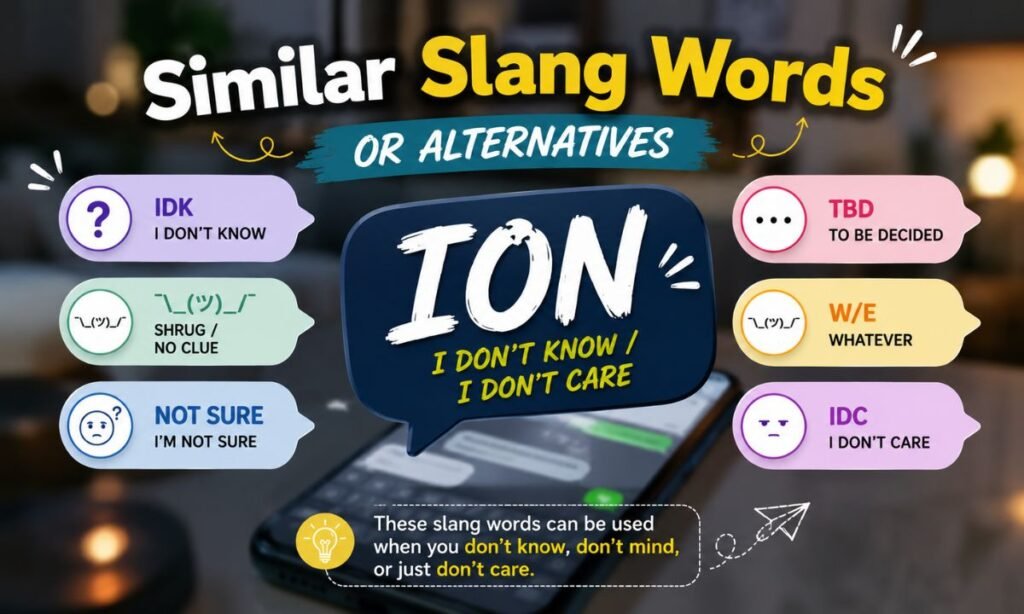
If ION makes sense to you now, these related slang terms will feel familiar too:
| Slang | Meaning | When to Use |
| IDK | I don’t know | When you genuinely have no answer |
| IDC | I don’t care | Casual, dismissive responses |
| TBH | To be honest | Sharing an honest opinion |
| ICYMI | In case you missed it | Sharing news or updates |
| IMO | In my opinion | Giving a personal take |
| FR | For real | Emphasizing sincerity |
| NGL | Not gonna lie | Admitting something honestly |
Frequently Asked Questions❓
Does ION mean “I don’t”?
Yes, in almost all casual texting contexts, ION means “I don’t.”
Is ION rude or offensive?
No, ION isn’t inherently rude :tone depends entirely on the rest of the sentence.
Can ION mean something else?
Occasionally, all-caps “ION” can mean “In Other News,” but this is far less common than the lowercase slang use.
Is it okay to use ION with older people?
It’s safer to use the full phrase “I don’t” with older audiences who may not recognize the slang.
Where did ION originate from?
ION originated from African American Vernacular English (AAVE) as a phonetic spelling of “I don’t.”
Should I use ION in professional messages?
No, ION should be avoided in emails, workplace chats, and academic writing.
Is ION the same as IDK?
Not exactly :ION means “I don’t,” while IDK specifically means “I don’t know.”
Final Thoughts 🎯
At the end of the day, ION is just a small, casual piece of internet language that reflects how people naturally speak :quick, relaxed, and full of personality. 🙌 Once you know it simply stands for “I don’t,” reading it in texts, comments, or DMs becomes second nature.
The key is knowing your audience: use ION freely with friends and on social media, but stick to full sentences in professional or formal settings. Master that balance, and you’ll never be confused by a text that just says “ion” ever again. 😄
